
 Made with Levo
RETRO FITTING

Structural RETROFITTING in construction
Retrofitting in construction refers to the process of modifying existing structures to improve their performance, Improve their service life, or accommodate updated requirements, including increased loads, revised building codes, or enhanced seismic resistance.
This practice is an essential and cost-efficient alternative to demolition and reconstruction, especially for heritage sites or structures located in densely developed areas.
This is particularly essential for older structures that may not meet current design standards or have experienced deterioration over time.
Retrofitting measures can range from minor repairs to comprehensive interventions, ensuring that buildings remain safe, functional, and meet the requirements of all previous compliances.
Main Reasons for Structural Retrofitting
The necessity for retrofitting generally arises from one or more of the following technical deficiencies or changes:
Seismic Exposure: The most common reason, especially in earthquake-prone areas, is to enhance the structure's resistance (strength, stiffness, and ductility) to modern seismic codes.
Change in Usage/Increased Load: When a building's function changes (e.g., from residential to commercial, or adding floors), the existing structure may need reinforcement to safely carry the increased loads.
Deterioration: Aging, environmental exposure, or material degradation (such as concrete carbonation or rebar corrosion) can reduce the load-carrying capacity of structural elements.
Design/Construction Errors: Rectifying structural weaknesses stemming from original design flaws or poor construction quality.
Compliance: Meeting new or updated building codes and regulations that may have changed since the structure's original construction.
Technical Retrofitting Methods
Retrofitting techniques are broadly classified into methods that enhance the strength and ductility of individual members or the overall structural system, and those that reduce the seismic demand on the structure.
1. Strengthening of Member
This includes increasing the cross-sectional area and/or adding reinforcing materials to existing structural members (columns, beams, slabs).
Jacketing: This is one of the most popular methods, involving encasing an existing member (e.g., a column or beam) with a new layer of material.
Reinforced Concrete (RC) Jacketing: Adds a layer of new concrete, longitudinal bars, and closely spaced stirrups/ties around the existing member. This increases strength, stiffness, and significantly improves ductility by providing confinement.
Steel Jacketing: Involves encasing the member with a welded steel plate or angle/strip cage, with the gap often filled with non-shrinkable polymer based grout. It offers high confinement and strength.
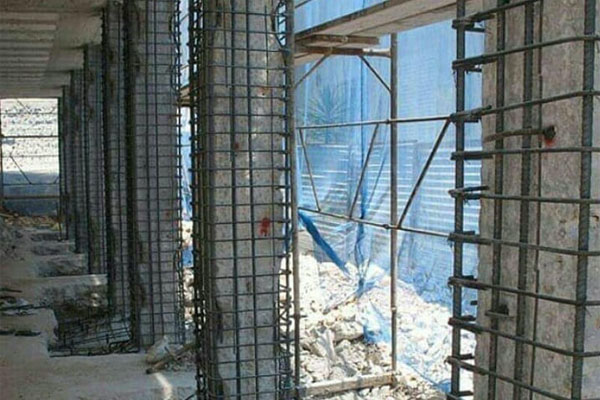
(Image of RC jacketing)
Fibre-Reinforced Polymer (FRP) Composites: Using sheets, strips, or wraps of materials like Carbon Fiber-Reinforced Polymer (CFRP) or Glass Fiber-Reinforced Polymer (GFRP) externally wrapped with epoxy resin.
FRP Wrapping (Confinement): For columns, wrapping provides high-strength confinement, dramatically increasing the axial load capacity and ductility of the concrete core.
FRP Bonding (Flexure/Shear): Strips are bonded to the tension face of beams/slabs for flexural strengthening or wrapped around the shear critical zone to enhance shear strength.
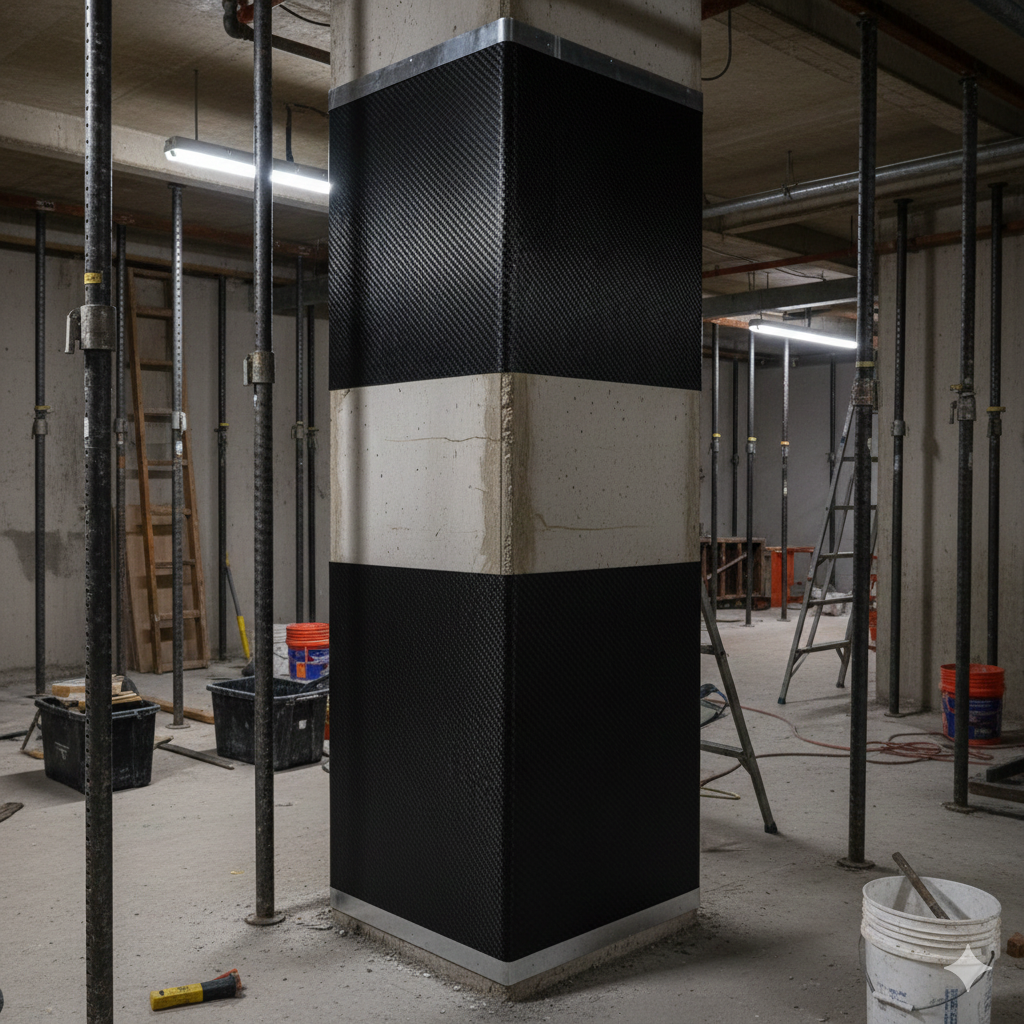
(Image showing Carbon Wrapped concrete column)
External Plate Bonding: Steel plates are bonded to the surface of concrete members using epoxy adhesives. This is generally used for flexural or shear strengthening, but debonding can be a failure concern.
Section Enlargement: Similar to jacketing, this technique primarily focuses on increasing the cross-sectional dimensions of a member by adding new reinforced concrete, thereby substantially enhancing its load-carrying capacity. This method is particularly effective where significant improvement in strength and stiffness is required, and it can be tailored to suit various structural configurations. By enlarging sections, the overall strength and flexibility of the structure are improved, making it a preferred choice for upgrading older buildings to meet current safety standards
2. Strengthening of System
These methods enhance the overall lateral load-resisting capacity of the entire structural system.
Adding New Shear Walls: Introducing new reinforced concrete walls strategically within the structure's plan. Shear walls provide a stiff and strong load path to resist lateral forces (like wind or seismic loads) and can be highly effective and economical.
Steel Bracing: Installing diagonal steel elements (X-bracing, V-bracing, K-bracing) within the existing structural bays. This increases the structure's stiffness and strength, acting as an energy scattering mechanism.
Infill Walls: Replacing non-structural infill walls with reinforced concrete or masonry to increase lateral stiffness and strength, though this must be carefully detailed to avoid short column effect or other local failures.
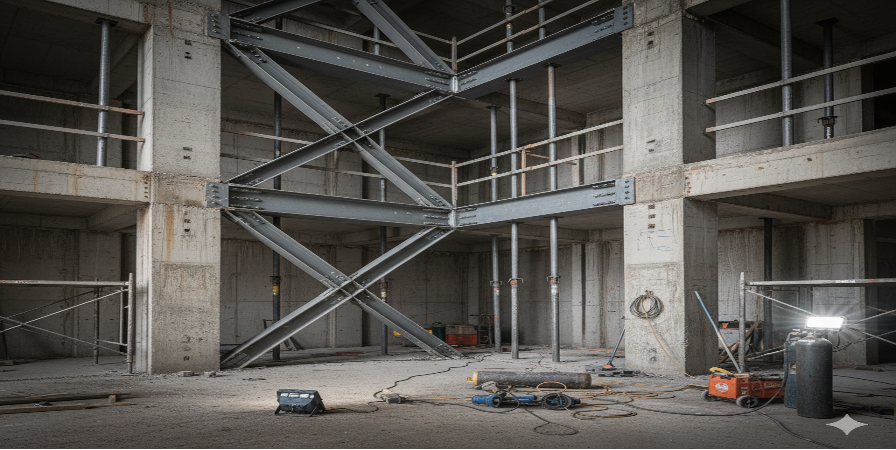
( Image showing Steel Bracing in concrete structure )
3. Methods for Reducing Responses
These methods focus on reducing the amount of seismic energy transmitted to the structure.
Base Isolation: Inserting seismic isolation bearings (e.g., Lead Rubber Bearings (LRB) or High Damping Rubber Bearings (HDRB)) between the foundation and the superstructure. This decouples the structure from the ground motion, significantly increasing the building's natural period and reducing the seismic forces transferred to the superstructure.
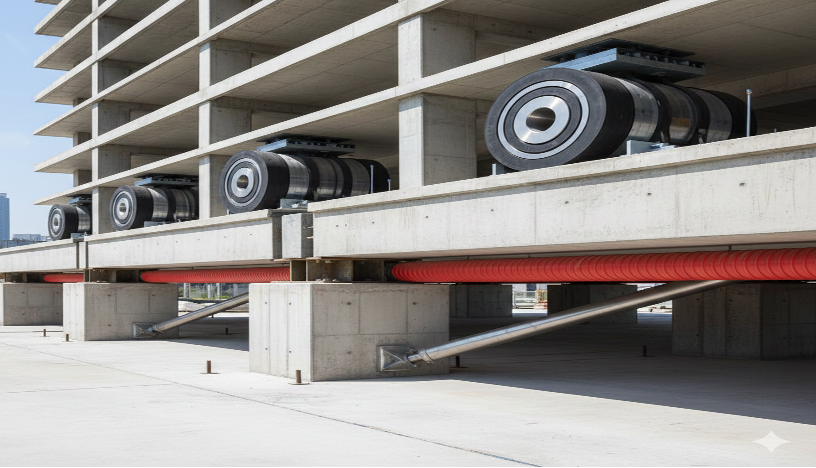
( Image showing Oil Dampers and Bearing Rollers for Base Isolation Sysytem)
Add on Devices ( Dampers) : Installing energy dissipation devices (dampers) like Viscous Fluid Dampers or Metallic Yield Dampers into the structure. These devices absorb kinetic energy during an earthquake, reducing overall structural movement and internal forces.
Mass Reduction: Removing non-structural elements or reducing the number of upper floors to decrease the structure's inertia force.
Specialized Materials in Retrofitting
The success of retrofitting relies heavily on advanced materials that can integrate effectively with the existing structure.
Material | Primary Application | Key Technical Advantage |
Fiber-Reinforced Polymers (FRP) | Column/Beam wrapping, Flexural/Shear strengthening | High strength-to-weight ratio, high stiffness, non-corrosive, minimal change in member size. |
Non-Shrink Grout/Micro-Concrete | Filling voids (jacketing), Plate bonding interface, Repairing cracks | Compensates for volume change, ensures a solid bond and stress transfer between old and new materials. |
Epoxy Resins | Injection into fine cracks, Bonding agent for FRP and steel plates | High adhesive strength, restores structural integrity of cracked concrete. |
Corrosion preventers/Coatings | Treating exposed reinforcement, Surface protection | Reduces the rate of rebar corrosion, extending the service life of repaired concrete. |
Design and Implementation Considerations
Retrofitting is a complex process requiring careful technical execution:
Risk & Exposure Assessment: A thorough investigation is first conducted, including non-destructive testing (NDT), material property tests (e.g., concrete core samples), and structural analysis to determine existing capacity and deficiencies.
Performance Objective Definition: The required post-retrofit performance level must be clearly defined (e.g., Life Safety, Immediate Occupancy).
Connection Details: The bond between the existing structure and the new strengthening material is critical. Techniques like roughening surfaces, adding shear keys, and using epoxy bonding agents are essential for ensuring monolithic action.
Construction Sequence: The execution plan must account for the temporary shoring and load transfer during the retrofitting process to prevent premature failure of the already distressed structure.

Making construction organized, transparent, and efficient





About T-Hub
Innovation Ecosystem
Quick Links